


Model your fund with confidence. Fully connected and scenario-driven.








How Intrinsiq transforms your forecasting workflows
Model multiple scenarios from live portfolio data

Proprietary Knowledge Base
Proprietary Knowledge Base
Proprietary Knowledge Base
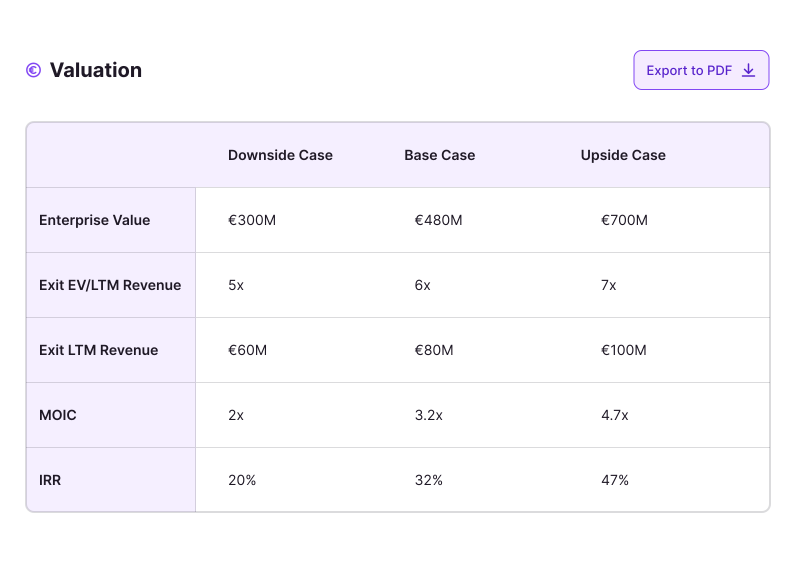
Base, upside, and downside built on actual investments
Intrinsiq Fund is always up to date with live portfolio valuations, KPI shifts, and new funding events. Model follow-on rounds, dilution, and changing assumptions over time. Compare base, upside, and downside scenarios side by side without maintaining complex spreadsheets.
Turn scenarios into exit outcomes
Proprietary Knowledge Base
Proprietary Knowledge Base
Proprietary Knowledge Base
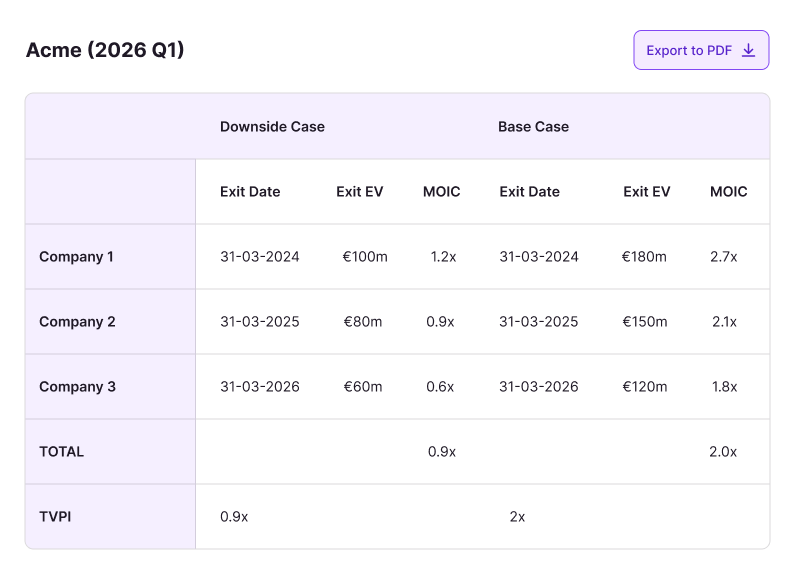
Exit timing, multiples, and distributions per scenario
Set exit timing and outcome assumptions per company and per scenario. Instantly see projected proceeds and liquidity pacing across the portfolio. Exit projections stay current as market multiples and company performance change.
See fund returns under every scenario
Proprietary Knowledge Base
Proprietary Knowledge Base
Proprietary Knowledge Base
Show LPs your road to DPI
Roll up scenario projections into IRR, TVPI, and DPI at fund level. Understand sensitivity and identify the key drivers behind different outcomes. Share a consistent, auditable fund outlook with IC and LPs.
Your fund analyst, on demand

Turn weeks of manual work in minutes. Every quarter.
From scattered spreadsheets to a live, scenario-driven fund model with auditable outcomes.

Built for investors who need real-time fund clarity

Frequently asked questions
Intrinsiq Fund is the fund-level modeling and scenario analysis module within the Intrinsiq platform. It enables private market investors to model fund performance, forecast cash flows, automate carry and waterfall calculations, and analyze return scenarios such as IRR, DPI, MOIC, and NAV. Intrinsiq Fund operates on top of Intrinsiq’s centralized portfolio and valuation data layer, ensuring consistency across portfolio, valuation, and fund-level analysis.
Unlike Excel-based fund models, Intrinsiq Fund is fully integrated with live portfolio data, valuations, and ownership structures. This removes manual data reconciliation, reduces errors, and ensures that fund scenarios always reflect the latest portfolio marks, cash flows, and assumptions. Version control, audit trails, and historical comparisons are built in by default, making fund analysis faster, more reliable, and audit-ready.
Intrinsiq Fund supports a wide range of fund-level scenarios, including base, upside, and downside cases. Users can model changes in exit timing, valuation multiples, growth assumptions, dilution, and ownership outcomes, and instantly see the impact on IRR, DPI, TVPI, NAV, and cash flow timing. Scenarios can be compared across funds, vintages, and portfolios using consistent assumptions.
Intrinsiq Fund automates complex carry and waterfall calculations across different fund structures, including preferred returns, catch-ups, tiered carry, and multiple share classes. Because these calculations are directly linked to portfolio valuations and ownership data, results are fully traceable from underlying assumptions to final distributions. This significantly reduces manual effort and minimizes errors in carry modeling.
Yes. Intrinsiq Fund is fully integrated with other Intrinsiq modules, including Intrinsiq Monitor and Intrinsiq Value. This means fund models automatically reflect the latest portfolio monitoring data, cash flows, and IPEV-compliant valuations. As a result, fund-level analysis is always aligned with portfolio-level reality, without manual data transfers between tools.
Intrinsiq Fund provides full transparency and traceability across fund models, assumptions, and outputs. All inputs, changes, and scenarios are versioned and documented, creating a clear audit trail. Auditors and internal stakeholders can easily review how fund outcomes were derived, reducing back-and-forth and significantly shortening audit cycles.
Intrinsiq Fund is used by venture capital, growth equity, and private equity firms, as well as fund controllers, CFOs, and investment teams responsible for fund modeling and reporting. It is particularly valuable for teams managing multiple funds, complex ownership structures, or frequent scenario analysis, and for firms that want to move away from spreadsheet-based fund modeling toward a scalable, institutional-grade platform.